
In the last few years, more and more Americans have been using diffusers at home. But because diffusers don’t often come with a manual, or at least not a useful one, most of us don’t know how long it’s safe to keep a diffuser running, and whether or not they can stay on overnight.
Diffusers should not be kept on overnight. The benefits of inhaling essential oils decrease after prolonged exposure, while the risks of health and safety hazards increase when a diffuser is on and unsupervised for long periods of time.
In this guide, I explain the problems of having a diffuser running through the night and why you should avoid it. Then I step you through how to use your diffuser to get the most out of it.
Why you should turn your diffuser off at night
There are many benefits in having a diffuser in your bedroom. In fact, there is plenty of scientific evidence that shows essential oils improve our physical and mental wellbeing by reacting with the olfactory nerves from our nose to our brains. But don’t leave your diffuser on overnight, here’s why:
1. Negative effects of long exposure
The inhalation method of absorbing essential oils (breathing in the smell) is the most popular in aromatherapy, and generally presents a very low level of risk of problems. Whereas topical applications (direct application to the skin) can cause skin reactions, and oral administration (swallowing) can badly hurt our gastrointestinal tract.
Inhaling vaporized oils from a diffuser, even in a small bedroom with poor ventilation, is unlikely to ever reach dangerous levels. BUT, prolonged exposure to essential oils increases the chances of developing side effects, including irritation in our mucous membranes.
Symptoms vary from sneezing, runny nose or congestion to respiratory distress and drowsiness. Whilst, rose, geranium, ylang ylang and other oils can cause headaches, fatigue or dyspnea in people that are sensitive to fragrances.
Fortunately, we gain the benefits of essential oils within 30 to 60 minutes of exposure. So we don’t need to be taking in essential oils all day long (even if we like the smell!).
2. Olfactory fatigue
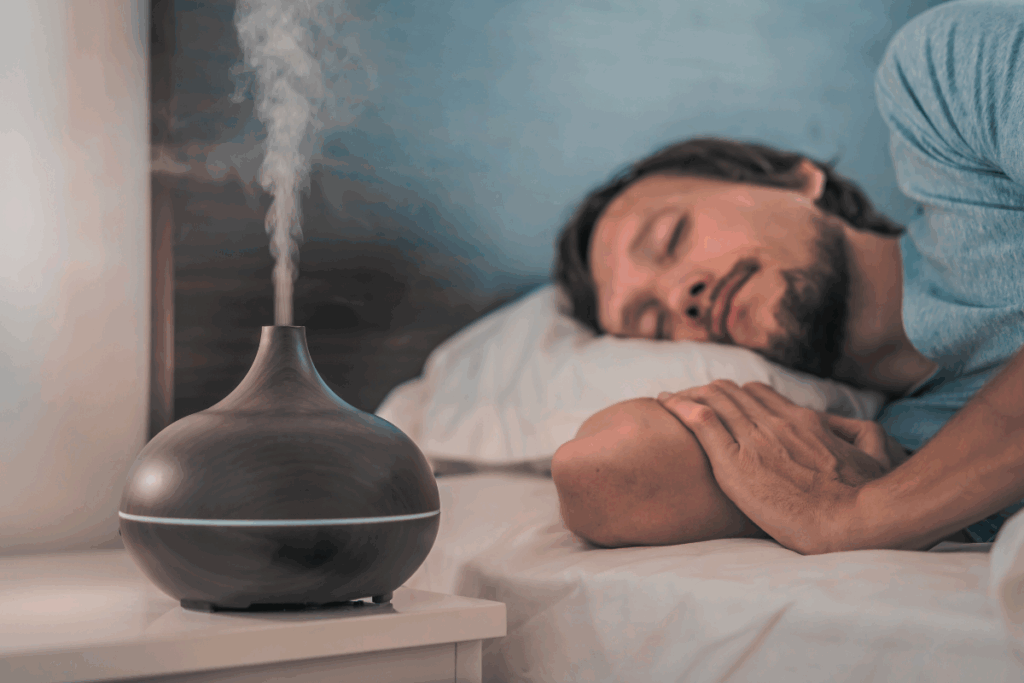
After an hour or so, our nervous system becomes used to the effects of any essential oil. This happens because of what’s called Olfactory fatigue, also known as temporary nose blindness. If you’ve ever noticed that you can walk into a room and notice a strong smell, but after a while you don’t notice it anymore, that’s Olfactory fatigue.
Our senses are literally saturated and stop reacting. This saturation means that we will no longer react, systemically or even sensorially, to the scent of the most essential oils after a while.
This means the intermittent diffusion of essential oils is healthier and more effective.
3. Fire risk
Then of course we have the most obviouse risk of any electrical device. Running a diffuser at night can pose a fire risk. While many diffusers run cold, some run hot, and can overheat creating a fire risk. Something we all want to avoid at night time when we aren’t awake to notice if our diffuser is getting too hot.
Essential oils are flammable but not explosive, and diffusers are relatively (not completely) safe. Heat powered diffusers have the potential to become a fire hazard from overheating or exposure to naked flames. Device malfunctions in electric diffusers filled with water, like the ultrasonic models, can also cause burns.
There are four recognised categories of diffusers (ultrasonic, evaporative, heat and nebulizers) depending on the vaporizing method. Within these groups, some diffusers are electric and others, like the traditional oil burner, are not. They all involve some degree of fire-risk.
When you sleep there is certainly a higher risk of fires because you are not awake to notice any problems.
Modern diffusers with automatic shutoff modes provide the opportunity for you to go to sleep while enjoying the benefits of a relaxing scent. But this does not avert all fire risks.
Cleaning your device regularly and drying thoroughly before putting it away reduce the chances of dangerous overheating. Placing your diffuser away from other flammable objects is also important. Some diffusers also need to be refilled with a certain frequency, and failure to do so can lead to overheating.
Risk factors
- Poor ventilation: it’s best to have some fresh air exchange when diffusing essential oils. This is harder during the night when windows and doors are generally closed.
- Airborne pollutants: some diffusers are filled with water, which creates an ideal environment for the growth of mold and mildew. The longer you leave it, the more chances for bacteria or fungi to develop, which lowers the quality of your indoor air and increases the risk of you getting sick.
- Pets: many people sleep with their pets in the room, and the scent of an essential oil can be overwhelming to small creatures. Consult your vet or research a specific oil before you diffuse it near your cat, dog, reptile or bird.
- Fire hazard: as with all electronic devices, a diffuser can cause a fire due to improper placement, improper maintenance, mechanical malfunctions and carelessness by the user of the device. When there are naked flames or water, the risk is higher.
How to use your diffuser at night
If you enjoy falling asleep to the scent of essential oils, a solution is to use a diffuser with a timer function. This allows you set a diffuser to run for 1-3 hours before it turns off.
This way you can enjoy the benefits of essential oils while being safe in the knowledge that the diffuser will turn off and not pose any risks.
Diffusers with timers and auto-shut off features that automatically shuts off at your choice of 30, 60, 120, or 180-minutes, are also available.
Important factors
- The size of the room where your diffuser is located. Small to medium rooms will saturate faster than larger, open spaces.
- The quality of the essential oil. Some products are incorrectly marketed as essential oils but they are actually just fragrances. The therapeutic benefits discussed in this article only apply to certified, pure essential oils.
- The quality of the diffuser. This article focuses on standard diffusers. I strongly advise against cheap, unregulated products from unknown providers.
- The age and health of the people in the room. Extra caution should be exercised when diffusing in a room with young children, pregnant or nursing women, or people with serious medical conditions. Always consult a doctor if this is the case.
- The dosage and ratio of the essential oils in the diffuser. Research each specific oil and read the instructions in your device’s manual to make sure you apply the right amounts to avoid damaging the diffuser or your health
As we mention above, from a therapeutic point of view, leaving a diffuser on overnight is an unnecessary risk. In this case, we refer to risks as in the low but possible chances of developing side effects.
Some articles suggest that your diffuser can stay on throughout the night as long as you only fill it with water, without adding any essential oils. But there are other challenges in leaving a diffuser unattended for several hours, regardless of the biological effects of the oils you infuse.
Using a diffuser without essential oils
A diffuser is made to be used with essential oils as the diffuser serves no other purpose (i.e. it does not humidify or purify the air). Other fluids, such as vanilla extract, citrus juices and some perfumes may be used instead of essential oils but may void any warranty.
For more information on what other items can be used as a substitute read this detailed guide.